
The American Psychological Association has highlighted that human decisions are often influenced by cognitive biases, emotions, and patterns of thinking that can shape judgment even when people believe they are acting logically. That observation has become increasingly relevant in sports prediction culture, where statistics and emotional reactions frequently exist side by side. Numbers may seem objective, yet the people interpreting them remain human.
The growth of prediction-focused communities across sports media, analytics platforms, and digital environments has changed how audiences engage with events. Data dashboards, historical performance records, and sources such as Didihub site (situs Didihub) illustrate how people increasingly seek information to understand broader patterns in sports activity and digital prediction spaces. What once involved simple conversations among friends has evolved into a larger culture of analysis and discussion.
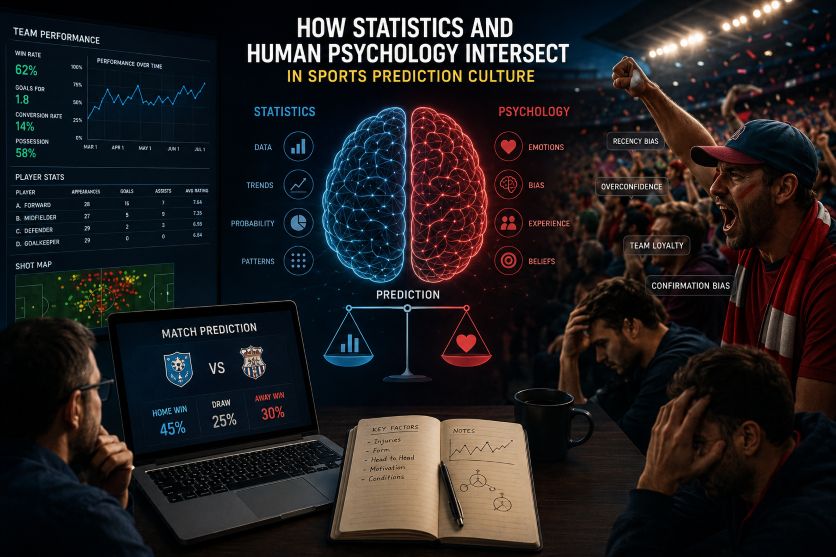
The Rise of Prediction Culture
Sports discussions have always included forecasts and opinions. Fans debated upcoming matches long before modern technology arrived. The difference today is scale. Digital platforms provide immediate access to statistics, injury reports, performance histories, weather conditions, and countless other data points.
McKinsey & Company has repeatedly noted that growing digital access has transformed how consumers process information and make decisions. Sports audiences now interact with a constant stream of data rather than isolated pieces of information. Mobile apps, live statistics, and analytical tools create environments where prediction feels increasingly tied to measurable evidence.
This development creates an interesting contradiction. Greater access to information can improve understanding, yet larger amounts of information can also increase confidence beyond what the available evidence actually supports.
Prediction culture sometimes creates the impression that more numbers automatically lead to greater certainty. Human behavior, however, rarely follows a perfectly predictable pattern.
Data Versus Emotional Bias
Thesis: Statistics Create Structure
There is a strong argument that data introduces discipline into prediction behavior. Statistical models can identify trends invisible to casual observation. Historical performance, possession rates, scoring efficiency, player workload, and situational context all help create a broader picture.
Harvard Business Review has discussed how data-driven systems often reduce reliance on instinct alone by introducing measurable indicators into decision-making processes. In sports contexts, numbers can provide structure and reduce random assumptions.
Many observers see this shift as a positive development because it moves conversations beyond personal impressions. Rather than relying entirely on emotions, discussions become more grounded in observable patterns.
Antithesis: Human Emotion Rarely Disappears
Yet statistics do not operate independently from the people reading them. Emotional attachment often enters the process quietly.
People may favor familiar teams, remember dramatic moments more strongly than ordinary events, or place extra attention on recent performances. Psychologists sometimes describe this as recency bias, where recent information appears more significant than older evidence.
The American Psychological Association has explained that people frequently rely on mental shortcuts when processing information. These shortcuts help simplify decisions but can distort interpretation.
A supporter of a particular team may view the same numbers differently from someone without that emotional connection. Statistics become filtered through expectations, experiences, and personal beliefs.
This pattern appears in many forms of digital prediction behavior. The broader sports prediction ecosystem often reflects how individuals combine measurable evidence with instinctive reactions. Data alone rarely removes emotional interpretation entirely.
Synthesis: Numbers and Emotion Usually Coexist
The debate between data and psychology may present a false choice. Human decision-making rarely exists at either extreme.
Statistics provide frameworks for understanding events, while psychology shapes how those frameworks are interpreted. Instead of competing forces, they often function together.
Sports prediction culture may therefore reveal less about mathematical certainty and more about how people process uncertainty itself.
The Challenge of Interpretation
Access to information does not automatically create understanding. Modern audiences face another challenge: deciding which information actually matters.
Large quantities of data can create complexity. Two people reviewing identical statistics may reach completely different conclusions because they prioritize different variables.
Massachusetts Institute of Technology (MIT) research has explored how information overload can affect human decision-making by making it harder to distinguish useful signals from background noise.
Sports environments contain numerous variables that constantly change. Injuries, fatigue, coaching adjustments, weather conditions, and individual performance fluctuations can alter outcomes in ways that historical records may not fully capture.
This uncertainty explains why prediction discussions often continue even when extensive data is available. People are not simply analyzing numbers. They are assigning meaning to those numbers.
Interpretation itself becomes part of the process.
The Broader Impact Beyond Sports
The influence of prediction culture reaches beyond sports environments. Similar behavior appears in finance, consumer trends, entertainment forecasting, and social media discussions. Discussions around changing patterns in global betting culture also reflect how digital participation and evolving online communities can shape the way people interact with prediction-based environments across different regions and platforms.
People increasingly interact with systems that provide probabilities, trends, and projected outcomes. Learning how emotions and statistics interact in sports may therefore offer broader insights into human behavior in digital environments.
The discussion also raises important questions about confidence and decision-making. Access to advanced tools may create a perception that uncertainty can be removed completely. Reality tends to be more complex.
Numbers can improve understanding, but they rarely eliminate unpredictability.
Responsible engagement also matters. Activities connected to prediction environments can involve financial or behavioral risks for some individuals. If participation begins affecting emotional well-being, relationships, or financial stability, seeking balance and setting limits becomes important.
Conclusion
Sports prediction culture reflects a larger human story. Statistics provide structure and measurable evidence, while psychology adds emotion, interpretation, and personal perspective. The interaction between the two shapes how people understand uncertainty.
As digital systems continue evolving, the broader sports prediction environment may become increasingly sophisticated. Yet human behavior will likely remain part of the equation. Numbers can guide interpretation, but people still decide what those numbers mean.
Perhaps the most interesting aspect is not whether statistics or psychology matters more. The more meaningful observation is that they continuously influence one another, creating a process that reflects both data and human nature.